Cash Optimization Software for accounting, finance and treasury teams
Automate and Optimize Idle Cash
The CFO Forecast Report
Cost discipline, AI readiness, and the idle cash every multi-bank CFO is leaving on the table. An interactive breakdown for CFOs at corporations with more than $5M in assets and two or more banking relationships.
Executive Summary
of CFOs now cite cost management as their top internal concern, up from 47% six months earlier.
of CFOs say AI will be very or extremely important to finance operations in the year ahead.
of CFOs with fully deployed AI see tangible value from those investments so far.
North American CFOs entered 2026 with renewed confidence, but Q2 is shaping up to be a quarter defined by competing pressures. Finance leaders are being asked to fund AI investment, tighten cost discipline, absorb supply chain shocks, and become strategic partners to the board, all at the same time.
Against that backdrop, one line item on the balance sheet is quietly underperforming at most mid-market companies: corporate cash. For CFOs running multiple banking relationships at corporations with more than five million in assets, idle cash sitting in low-yield accounts is a self-inflicted drag on earnings, and it is the easiest margin win available this quarter.
What this report covers
- 01 Three macro forces defining the Q2 2026 CFO agenda
- 02 The hidden cost of fragmented, multi-bank cash management
- 03 A four-step framework to turn idle cash into a yield engine
- 04 Interactive ROI model for your own balance sheet
- 05 How Likwidity helps forward-looking CFOs act now
The thesis in one line
Every macro force in Q2 2026 points in the same direction. Cash optimization is one of the only initiatives that lets a CFO respond to cost discipline, AI readiness, and board scrutiny at once, in weeks rather than quarters, without brokers or a TMS overhaul.
The Q2 2026 CFO Agenda
Three forces are reshaping what boards and CEOs expect from their finance leaders this quarter. None are new, but the pressure has intensified.
Cost discipline is back at the top of the agenda
In Deloitte's Q1 2026 CFO Signals Survey, 52% of finance leaders named cost management their most worrisome internal concern, up from 47% six months earlier. Supply chain disruption jumped from 35% to 52% as the top external worry in the same period. Nearly seven in ten CFOs (68%) say finance has the greatest responsibility for cost oversight, excluding the CEO and board.
AI expectations are rising faster than AI returns
87% of CFOs predict AI will be very or extremely important to finance in the year ahead, and 54% say integrating AI agents into finance is a top transformation priority. Yet among organizations that have fully deployed AI, only 21% believe those investments have delivered tangible value. Just 16% of CEOs describe their CFO as AI-savvy, according to Gartner.
Data trustworthiness is a CFO-level control
Gartner's 2Q26 CFO Report identifies data quality as a top barrier to AI adoption for the third consecutive year. Among CFOs already using AI, inadequate data quality is now the single biggest obstacle to further progress. Gartner's recommendation is blunt: data observability must be a control that CFOs personally lead on.
- ▸Frequent forecast revisions caused by data errors
- ▸Manual reconciliation during audits
- ▸Rising cloud and data costs with unclear ROI
- ▸Stalled AI initiatives caused by unreliable inputs
The Multi-Bank Cash Problem
If you work with two or more banks at a company over $5M in assets, there is almost certainly a gap between the yield your cash is earning and the yield it could be earning.
How the gap forms
Each bank quotes rates independently. Each relationship manager negotiates in isolation. Comparing rates across banks means emails, spreadsheets, and phone calls, a process that punishes the treasury team for doing the right thing. So cash sits in low-yield or zero-yield accounts, earning returns that barely keep pace with inflation.
What it costs
Likwidity research on fragmented treasury operations found manual treasury processes consume 15 to 20 hours per week of senior treasury time, and the average multinational leaves around $2.3M annually on the table through suboptimal cash placement.
Margin improvement available on idle corporate cash through competitive multi-bank price discovery.
Hours per week senior treasury staff lose to manual cash positioning and rate chasing.
Reduction in manual treasury tasks Likwidity clients report after automating rate discovery.
The three questions every multi-bank CFO should answer
Where should we actually be investing our cash? Beyond the basic checking account, what options exist, and when did we last compare them?
Which of our banks is paying the best interest right now, and how confident are we that the rate we are getting is competitive?
What is the credit rating of the banks we deal with, and are we inadvertently concentrating counterparty risk?
If your team cannot answer these three questions in under an hour, your cash is not being managed. It is being stored.
A Q2 Action Framework
Four steps CFOs can run this quarter without waiting for a treasury management system implementation. Framework adapted from Gartner's data optimization path applied to corporate cash.
Assess & Benchmark
Process + Tech
- ▸Map data flows across banks and accounts
- ▸Quantify the yield gap vs. market rates
- ▸Identify counterparty concentration
Invest Strategically
Tech + People
- ▸Leverage platforms for end-to-end visibility
- ▸Skip 18-month TMS overhauls
- ▸Train teams on rate comparison
Implement & Integrate
Process + People
- ▸Deploy in high-impact areas first
- ▸Automate alerts and audit trails
- ▸Integrate with governance
Align & Optimize
Strategy + Tech + People
- ▸Fold yield into board reporting
- ▸Position as FinOps story
- ▸Partner with CIO / CDAO on data
Why this framework works in Q2 2026
Every step in this framework produces evidence the board wants to see. Step 1 gives you benchmark data. Step 2 gives you a cost-disciplined tech decision. Step 3 gives you measurable yield. Step 4 gives you a story that ties corporate cash into the wider AI and FinOps agenda. That is four board-ready wins from a single quarter's work.
Interactive ROI Model
Adjust the inputs below to size the Q2 opportunity on your own balance sheet.
Your inputs
Drag the sliders or type values directly.
Conservative: +2pp yield uplift, 50% manual task reduction.
Additional yield
From multi-bank price discovery and rate optimization.
Labor reclaimed
Annual treasury hours freed by automation.
Current state vs. with Likwidity
Annual value generated from your corporate cash.
Like what you see?
Run the full model with your actual bank data, or book a walkthrough.
Where Likwidity Fits
An automated cash optimization platform built for mid-market and enterprise finance leaders with more than one banking relationship.
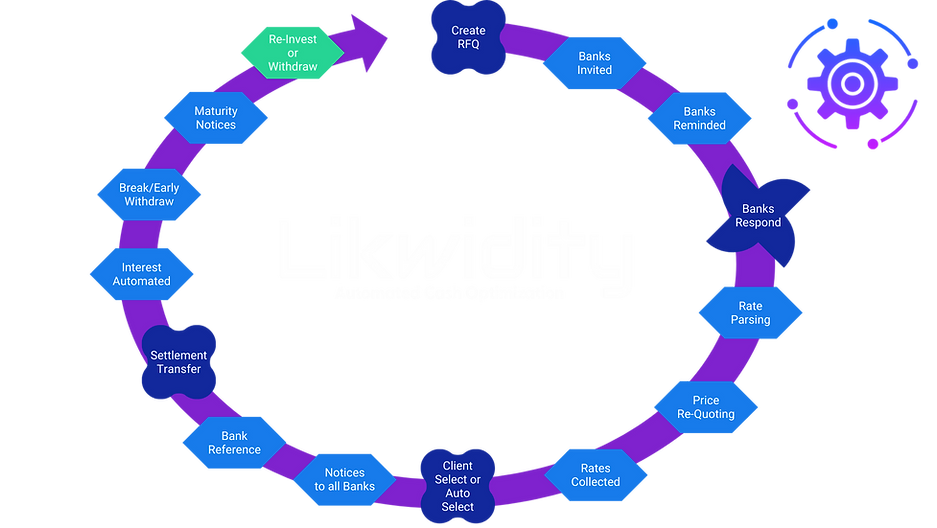
One portal, one RFQ
Automated, non-brokered price discovery over corporate cash funds, plus risk, counterparty, limit, and maturity management.
Zero access to your funds
A pure software layer. Likwidity never receives or controls cash, and does not interpose between you and your RMs.
No commissions, no markups
Fixed monthly fee. You receive the full quoted rate from your banks. No rebates, no hidden spreads.
SaaS, PaaS, or white-label
Built for group companies, multinationals, and shared-service finance teams needing centralized, multi-currency price discovery.
Higher returns through dynamic rate optimization.
Reduction in manual treasury tasks via automation.
To deliver governed multi-bank reporting, not quarters.
Why this matters for Q2
Every macro force in this report points in the same direction. Boards want measurable AI wins. Profit margins are compressing. Cost management is back on the front page. Data trustworthiness is now a CFO-level control. A cash optimization program is one of the only initiatives that lets a CFO respond to all four at once, in weeks rather than quarters, with full governance and without touching existing banking relationships.
Ready to close the yield gap this quarter?
Visit likwidity.com to see how forward-looking CFOs are turning idle cash into a measurable Q2 win, without brokers, without a TMS overhaul, and without giving up control of their banking relationships.
The CFO Forecast Report
Cost discipline, AI readiness, and the idle cash every multi-bank CFO is leaving on the table. An interactive breakdown for CFOs at corporations with more than $5M in assets and two or more banking relationships.
Executive Summary
of CFOs now cite cost management as their top internal concern, up from 47% six months earlier.
of CFOs say AI will be very or extremely important to finance operations in the year ahead.
of CFOs with fully deployed AI see tangible value from those investments so far.
North American CFOs entered 2026 with renewed confidence, but Q2 is shaping up to be a quarter defined by competing pressures. Finance leaders are being asked to fund AI investment, tighten cost discipline, absorb supply chain shocks, and become strategic partners to the board, all at the same time.
Against that backdrop, one line item on the balance sheet is quietly underperforming at most mid-market companies: corporate cash. For CFOs running multiple banking relationships at corporations with more than five million in assets, idle cash sitting in low-yield accounts is a self-inflicted drag on earnings, and it is the easiest margin win available this quarter.
What this report covers
- 01 Three macro forces defining the Q2 2026 CFO agenda
- 02 The hidden cost of fragmented, multi-bank cash management
- 03 A four-step framework to turn idle cash into a yield engine
- 04 Interactive ROI model for your own balance sheet
- 05 How Likwidity helps forward-looking CFOs act now
The thesis in one line
Every macro force in Q2 2026 points in the same direction. Cash optimization is one of the only initiatives that lets a CFO respond to cost discipline, AI readiness, and board scrutiny at once, in weeks rather than quarters, without brokers or a TMS overhaul.
The Q2 2026 CFO Agenda
Three forces are reshaping what boards and CEOs expect from their finance leaders this quarter. None are new, but the pressure has intensified.
Cost discipline is back at the top of the agenda
In Deloitte's Q1 2026 CFO Signals Survey, 52% of finance leaders named cost management their most worrisome internal concern, up from 47% six months earlier. Supply chain disruption jumped from 35% to 52% as the top external worry in the same period. Nearly seven in ten CFOs (68%) say finance has the greatest responsibility for cost oversight, excluding the CEO and board.
AI expectations are rising faster than AI returns
87% of CFOs predict AI will be very or extremely important to finance in the year ahead, and 54% say integrating AI agents into finance is a top transformation priority. Yet among organizations that have fully deployed AI, only 21% believe those investments have delivered tangible value. Just 16% of CEOs describe their CFO as AI-savvy, according to Gartner.
Data trustworthiness is a CFO-level control
Gartner's 2Q26 CFO Report identifies data quality as a top barrier to AI adoption for the third consecutive year. Among CFOs already using AI, inadequate data quality is now the single biggest obstacle to further progress. Gartner's recommendation is blunt: data observability must be a control that CFOs personally lead on.
- ▸Frequent forecast revisions caused by data errors
- ▸Manual reconciliation during audits
- ▸Rising cloud and data costs with unclear ROI
- ▸Stalled AI initiatives caused by unreliable inputs
The Multi-Bank Cash Problem
If you work with two or more banks at a company over $5M in assets, there is almost certainly a gap between the yield your cash is earning and the yield it could be earning.
How the gap forms
Each bank quotes rates independently. Each relationship manager negotiates in isolation. Comparing rates across banks means emails, spreadsheets, and phone calls, a process that punishes the treasury team for doing the right thing. So cash sits in low-yield or zero-yield accounts, earning returns that barely keep pace with inflation.
What it costs
Likwidity research on fragmented treasury operations found manual treasury processes consume 15 to 20 hours per week of senior treasury time, and the average multinational leaves around $2.3M annually on the table through suboptimal cash placement.
Margin improvement available on idle corporate cash through competitive multi-bank price discovery.
Hours per week senior treasury staff lose to manual cash positioning and rate chasing.
Reduction in manual treasury tasks Likwidity clients report after automating rate discovery.
The three questions every multi-bank CFO should answer
Where should we actually be investing our cash? Beyond the basic checking account, what options exist, and when did we last compare them?
Which of our banks is paying the best interest right now, and how confident are we that the rate we are getting is competitive?
What is the credit rating of the banks we deal with, and are we inadvertently concentrating counterparty risk?
If your team cannot answer these three questions in under an hour, your cash is not being managed. It is being stored.
A Q2 Action Framework
Four steps CFOs can run this quarter without waiting for a treasury management system implementation. Framework adapted from Gartner's data optimization path applied to corporate cash.
Assess & Benchmark
Process + Tech
- ▸Map data flows across banks and accounts
- ▸Quantify the yield gap vs. market rates
- ▸Identify counterparty concentration
Invest Strategically
Tech + People
- ▸Leverage platforms for end-to-end visibility
- ▸Skip 18-month TMS overhauls
- ▸Train teams on rate comparison
Implement & Integrate
Process + People
- ▸Deploy in high-impact areas first
- ▸Automate alerts and audit trails
- ▸Integrate with governance
Align & Optimize
Strategy + Tech + People
- ▸Fold yield into board reporting
- ▸Position as FinOps story
- ▸Partner with CIO / CDAO on data
Why this framework works in Q2 2026
Every step in this framework produces evidence the board wants to see. Step 1 gives you benchmark data. Step 2 gives you a cost-disciplined tech decision. Step 3 gives you measurable yield. Step 4 gives you a story that ties corporate cash into the wider AI and FinOps agenda. That is four board-ready wins from a single quarter's work.
Interactive ROI Model
Adjust the inputs below to size the Q2 opportunity on your own balance sheet.
Your inputs
Drag the sliders or type values directly.
Conservative: +2pp yield uplift, 50% manual task reduction.
Additional yield
From multi-bank price discovery and rate optimization.
Labor reclaimed
Annual treasury hours freed by automation.
Current state vs. with Likwidity
Annual value generated from your corporate cash.
Like what you see?
Run the full model with your actual bank data, or book a walkthrough.
Where Likwidity Fits
An automated cash optimization platform built for mid-market and enterprise finance leaders with more than one banking relationship.
One portal, one RFQ
Automated, non-brokered price discovery over corporate cash funds, plus risk, counterparty, limit, and maturity management.
Zero access to your funds
A pure software layer. Likwidity never receives or controls cash, and does not interpose between you and your RMs.
No commissions, no markups
Fixed monthly fee. You receive the full quoted rate from your banks. No rebates, no hidden spreads.
SaaS, PaaS, or white-label
Built for group companies, multinationals, and shared-service finance teams needing centralized, multi-currency price discovery.
Higher returns through dynamic rate optimization.
Reduction in manual treasury tasks via automation.
To deliver governed multi-bank reporting, not quarters.
Why this matters for Q2
Every macro force in this report points in the same direction. Boards want measurable AI wins. Profit margins are compressing. Cost management is back on the front page. Data trustworthiness is now a CFO-level control. A cash optimization program is one of the only initiatives that lets a CFO respond to all four at once, in weeks rather than quarters, with full governance and without touching existing banking relationships.
Ready to close the yield gap this quarter?
Visit likwidity.com to see how forward-looking CFOs are turning idle cash into a measurable Q2 win, without brokers, without a TMS overhaul, and without giving up control of their banking relationships.

Simpler. Better. Faster. Profitable.
What does cash optimization mean?
Automated Liquidity Management for Business
Real-time, multi-currency visibility and controls with automated placements and hedging-friendly workflows. Boost yields by up to ~2% without brokers or middle-men.

How to implement cash optimization
Transforming the gap between accounting and finance into profits
Bridging the gap between corporate cash management and strategic revenue growth
Automate
- End-to-end cash operations
- Quote gathering
- Approval
- Execution
- Confirmation
- Reconciliation
Reduce manual process and increase yields
How to compare the best corporate savings rates
Meet fiduciary responsibilities to ensure diversification over cash funds

Maximize Returns with Automation
Maximize returns on idle cash with an automated interest discovery marketplace to compare rates from 10+ banks in one click and place deposits directly, boosting yields by up to ~2% without brokers.
- Automatically compare bank rates & performance
- Automated dashboard reporting
- Audit trail and compliance
- Monitor risk policies, credit ratings, and limits
- Multi-bank & Multi-currency
Burdened by heavy audit and compliance evidence for governance, limits, and approvals across entities and geographies?
Embedded governance enforces approval hierarchies, counterparty limits, and generates audit trails, reducing audit prep time by 80% and aligning with Big4 due-diligence standards.
Automated Cash Optimization
Idle cash-Sub optimal return
Is your Idle and surplus cash earning suboptimal interest due to fragmented, manual rate discovery across multiple banks?
Automated
Maximize returns on idle cash with an automated interest discovery marketplace to compare rates from 10+ banks in one click and place deposits directly, boosting yields by up to ~2% without brokers.
Group companies and Cross Border
For group companies and cross-border units who don't need or have an expensive treasury system or complex bank arrangement. Not having a centralized and standardized process can allow idle cash at business units to lose dramatically far more than~$20k interest income per $1m cash balances
Expertise and Knowledge
Demonstrate best-interest decision-making with automated audit trails, counterparty diversification, and Big-4-aligned governance reporting. Nonprofit treasurers, CFOs, and trustees can prove due diligence at every placement, cutting audit prep time by 80%.
Simpler. Better. Faster. Profitable.
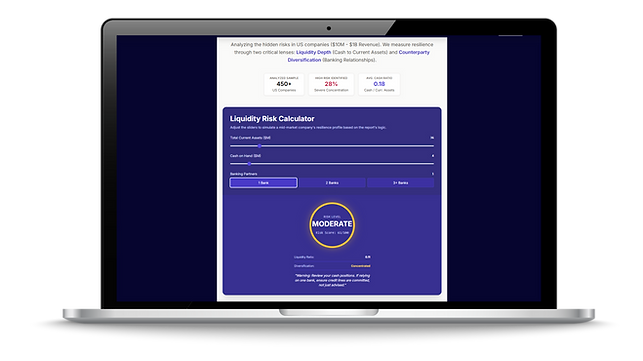
Determine your Risk Resilience Today
Effortlessly Optimize Working Capital
Transactions on platform
Largest single transactions
Transactions for 30 day duration
Largest interest benefit per transaction
Saved per month